
Trace Former Benton County Owners Through Time
Former owners emerge from a sequence of deeds, never from a single tax card. Start with the newest deed reference on the parcel. Identify that deed's grantor. Then find the instrument by which that same grantor acquired the land. One transfer at a time, the chain builds backward. Benton County's online period and its older courthouse era demand different sources, so carry each transfer date, legal description, and book and page citation across the divide without letting the trail go cold.
| Transfer source | Time span | Custodian | Ownership clue |
|---|---|---|---|
| Delta deed index | 1994 to present | Benton County Chancery Clerk | Grantor, grantee, instrument, date, book/page, and legal keys |
| Historic deed books and indexes | Before 1994 | Chancery Clerk courthouse collection | Earlier recorded transfers tied by names and legal descriptions |
| MDAH Series 2050 | 1799 to 1980 and undated | Mississippi Department of Archives and History | Original and microfilmed Benton County records |
| MDAH Series 1202 | 1870 and late nineteenth century items | MDAH Digital Archives | Land and personal assessment context |
The online index is the best opening for a modern chain. It carries the trail back only so far. Once you reach 1993 or earlier, bring the last reliable grantor, grantee, book and page, and subdivision or section-township-range description to the courthouse. Archive assessment material adds helpful context. But a tax-roll name alone never replaces a deed in the former-owner chain.
Build a Benton County Deed Chain Backward
A good chain table preserves facts and leaves uncertainty visible. Benton County's result screen supplies filing date, instrument date, instrument type, grantors, grantee, deed book and page, instrument number, and legal description. Capture all of them. Enter one row per verified transfer. Let gaps stay openly blank rather than guessing at links the property records do not support.
| Transfer date | Grantor to grantee | Deed type | Book/page |
|---|---|---|---|
| Newest verified filing | Immediate former owner to current grantee | Use the index code and full label | Record the cited volume and page |
| Prior verified filing | Earlier owner to immediate former owner | Warranty, quitclaim, trustee, estate, or other transfer | Match the same land description |
| Earlier link | Earlier grantor to earlier grantee | Do not assume every instrument is a sale | Continue until the 1994 boundary |
The inspected 2004 warranty deed illustrates the evidence available: filing and instrument dates, four grantors, one grantee, book 0164/page 0520, instrument 4001262, and a Lamar lot plus section-township-range description. It is an example of the fields to capture, not a chain for an unrelated address.
Read Benton County's Prior-Transfer Results
The Benton County deed-index result list shows names, dates, instrument codes, book and page entries, and land-description keys. Those fields help separate true prior owners from lien and release parties.
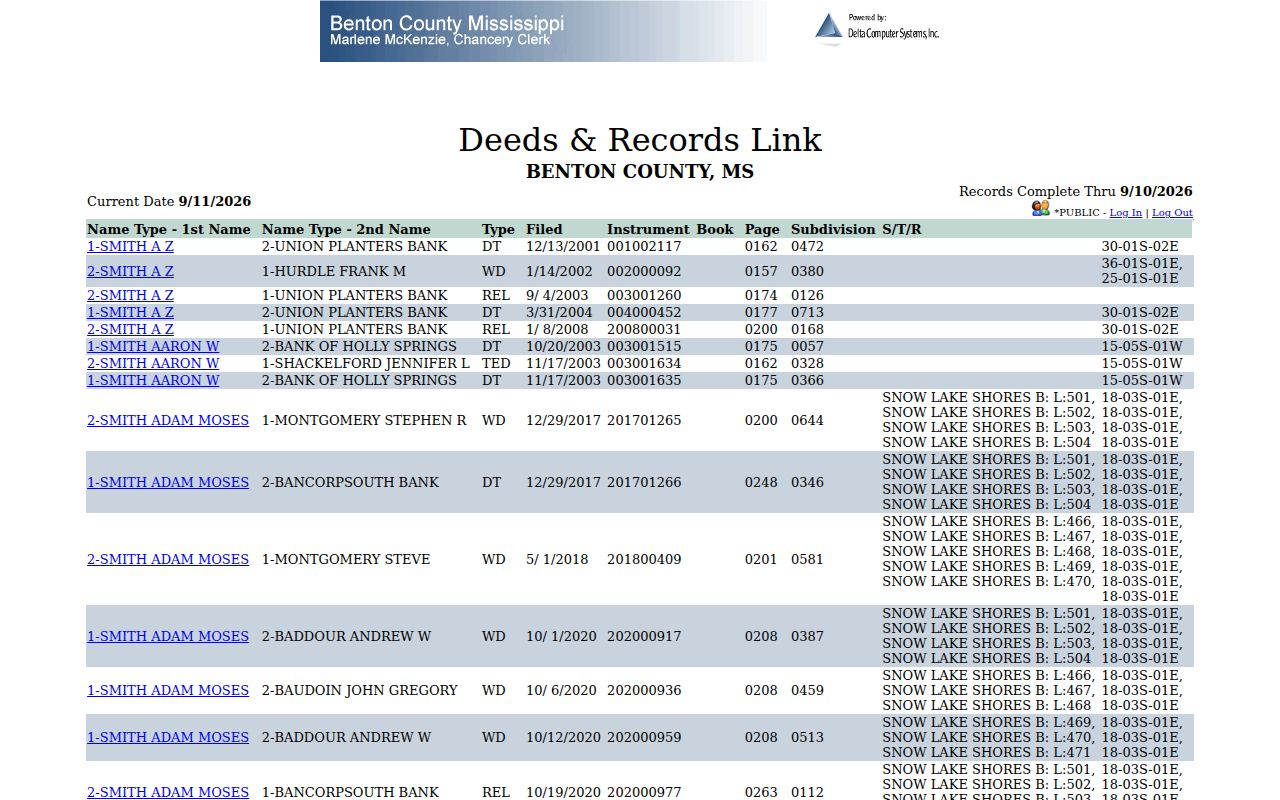
Codes carry meaning. WD, QCD, REL, DT, and TED each signal a different kind of event. A release or deed of trust may touch the parcel without conveying ownership at all, so classify every row before adding it to the backward chain of deed records.
Note: Preserve both filing and instrument dates because the order in which papers were signed and recorded can differ.
Reconstruct Benton County Ownership in Reverse
The Benton Deeds & Records Link accepts a grantor or grantee name, a partial name, book and page, filing date, section-township-range, subdivision with block and lot, or instrument number. Names establish the sequence. The legal description guards it. Without that guard, you risk joining two different parcels once owned by the same person into one false chain.
- Take the current parcel's latest deed book/page and locate that instrument.
- Read the grantor who conveyed to the present grantee, then record the full legal description.
- Search that grantor as an earlier grantee and match the same subdivision-lot or sectional land.
- Repeat the grantee-to-later-grantor link until reaching the online cutoff or a genuine gap.
- Continue in courthouse deed books and reverse indexes for the earlier period.
- Grantor
- The party conveying the recorded interest.
- Grantee
- The party receiving the recorded interest.
- Chain of title
- The linked sequence of instruments affecting the same land.
- Reverse index
- An index arranged to help locate parties in the opposite deed role.
- Quitclaim and warranty deed
- Different deed forms that may both appear as ownership links.
Go Beyond Benton's 1994 Online Boundary
The online label is blunt: 1994 to present. That is not when Benton County began keeping land records. Ask the Chancery Clerk at the courthouse for the historic grantor-grantee indexes and deed books. Bring the last known book and page plus the legal description. Rural tracts often track better through section, township, range, and acreage. A road address added later can muddy the search. Platted lots follow subdivision, block, and lot instead.
Online cutoff. Benton County's web deed index begins in 1994. Former owners before that boundary require courthouse deed books, microfilm, or archive records.
To go deeper, contact the clerk directly at 662-224-6300 or write to P.O. Box 218, Ashland, MS 38603. Ask whether a public terminal or index-book search is available, and confirm the current copy terms before you mail a request. The paper record at the courthouse still controls whenever a portal entry looks incomplete.
Extend a Benton County Chain at MDAH
The digital Series 1202 at MDAH exposes an 1870 land item along with later nineteenth-century land and personal assessment rolls, and the Series 2050 finding aid covers 1799 through 1980 plus undated material. County microfilm came from courthouse holdings, MDAH explains, and its Media Room is self-service. Original boxes require an Archival Reading Room request. Before a visit, note the catalog title, roll or box, volume, and date range. These holdings bridge context and point toward likely books. FamilySearch's Mississippi wills-and-deeds collection offers another lead, though Benton coverage must be confirmed item by item. Bond Memorial Library in Ashland may hold local histories or newspaper material, but it lists no directory or microfilm years online.
Follow Benton County Estate Transfers Carefully
A clean sale-to-sale sequence breaks when land moves through probate, heirship, a life estate, or a trustee. Benton County's deed-type list includes administrator's deeds, executor's deeds, affidavits of heirship and death, wills, life-estate deeds, and trustee deeds. Search those types. Search the Chancery case record too. A named former owner who vanishes without a standard warranty or quitclaim conveyance usually left an estate behind. Chancery cases and images are available online from August 2010 forward. Older estate files may still need the clerk. A death certificate or a tax-roll change can point to the event, but neither proves the ownership transfer. Keep probate references beside the deed-chain rows, never in place of them.
Note: A tax-sale purchaser or redeemed-sale entry is a clue that must be checked against redemption and land records.
Know the Limits of Benton County Former-Owner Research
Benton County has no verified courthouse fire. No complete starting date exists for every deed series. Do not turn that gap into a story about lost books. Broad date ranges are not continuous survival. MDAH Series 2050's long span can mislead. It does not mean every type of Benton land record persists across it. Cite the exact volume or instrument you examined. Let the property records speak for themselves.
Lawful use. Former-owner research supports house history, estate work, and property diligence. Never use it to track, stalk, harass, or harm a living person.
A rebuilt chain of owners is research, never a title opinion. The facts can still mislead. A deed in the Benton County deed records may transfer only a partial interest. It may reserve mineral or access rights, or lean on another instrument entirely. Before acting on a parcel number or a suspected owner of record, get a certified copy. Let a qualified professional settle any legal title question.